
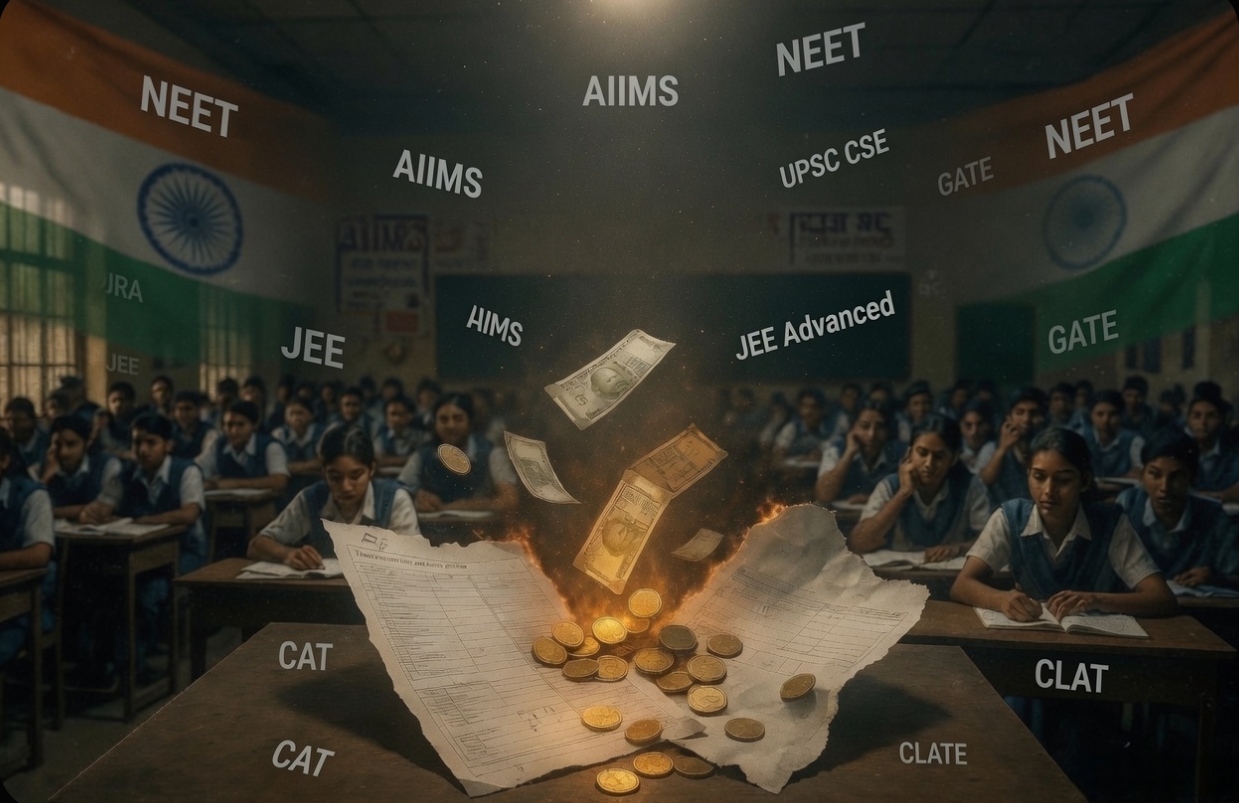
India’s paper leak scandals are not a new crisis invented by any single government or exam body. They represent a genuine, decades-old legacy problem embedded in a deeply flawed education system. From the AIPMT era through Vyapam, REET, UGC-NET irregularities, and the repeated NEET controversies of 2024 and 2026, the pattern is depressingly consistent. High-stakes competitive exams, combined with inadequate school-level preparation and intense societal pressure for limited seats in engineering, medicine, and government jobs, have created fertile ground for corruption. Unscrupulous networks involving middlemen, printing staff, and crucially, elements within the coaching ecosystem have repeatedly exploited these vulnerabilities for profit.
Yet the current wave of organised protests, including those at Jantar Mantar demanding ministerial resignations and systemic upheaval, increasingly appears driven more by political opportunism than by a serious commitment to fixing the root causes. At the heart of the problem lies the coaching industry itself. An industry that both manufactures the demand for shortcuts and, in its shadiest corners, has been willing to supply leaked papers to students and families ready to pay hefty sums. Any genuine, permanent solution to paper leaks will inevitably require a serious crackdown on the very coaching operators who are now loudly supporting or amplifying these protests.
The structural failures are clear. Formal schooling often fails to equip students for the rigour of JEE, NEET or civil services exams. Curricula emphasise rote learning or “Ratta-fication”, over conceptual understanding. Classrooms are overcrowded, and many teachers are overburdened. This vacuum has allowed the coaching sector to flourish as “shadow education.” What began as supplementary help has evolved into a parallel system that dictates priorities for millions of aspirants. The industry’s economic footprint is substantial, valued at around USD 7.2 billion in 2025 with projections to nearly double by 2034. It thrives on parental anxiety, urban migration to hubs like Kota and Sikar, and the promise of an “edge” in hyper-competitive exams.
This demand-side pressure is real. Students and families, often from modest backgrounds, pour lakhs into coaching fees, hostels, and materials because the system rewards those who can afford the best preparation. When that preparation includes access to leaked or “guess” papers sold for tens of lakhs, the moral hazard becomes obvious. Investigations into the 2026 NEET leaks, for instance, have repeatedly pointed to networks where consultants and coaching-linked operators facilitated the circulation of question papers or answer keys through digital channels and physical handovers. The incentive structure is perverse: the more the system rewards narrow exam-cracking skills, the greater the temptation for some players to cut corners or engage in outright fraud.
Public discourse around recent leaks has rightly highlighted student distress, including tragic mental health consequences and suicides in coaching hubs. These are not fabricated grievances. However, the organised protests that have followed, complete with political sloganeering, demands for immediate resignations, and sustained agitation, frequently sidestep the uncomfortable truth about who benefits most from the status quo. While student anger is understandable, the framing often reduces complex institutional failures to a simplistic narrative of governmental incompetence. This political overlay distracts from the harder, less glamorous work of systemic reform.
Evidence from ground-level actions further complicates the picture. In Prayagraj, certain coaching centres publicly backed student marches protesting alleged irregularities in recruitment exams. Within days, authorities sealed some of these premises citing fire safety and building violations. Proprietors claimed retaliation. Whether or not the timing was coincidental, it underscores a broader pattern: segments of the coaching world are quick to position themselves as champions of student causes when leaks surface, even as investigations elsewhere reveal coaching-linked operators entangled in leak networks.
It won’t be an exaggeration to say that the same “coaching centres ecosystem” long responsible for enabling paper leaks is now supporting protests, captures a genuine hypocrisy. These operators profit from a system that keeps students dependent on expensive, high-pressure preparation. They benefit when exams remain opaque enough that “insider” access commands a premium. Yet when public outrage erupts, some pivot to protest support, perhaps to deflect scrutiny or maintain goodwill among aspirants. Meanwhile, broader achievements in expanding educational infrastructure, IITs rising from 16 to 23, AIIMS from 7 to 23, significant growth in medical seats and universities since 2014, are downplayed or ignored in the heat of agitation. The focus stays narrowly political rather than on why the underlying demand for leaks persists.
A permanent solution cannot be limited to better encryption, CCTV, or post-exam inquiries, important as these are. Technology alone has not stopped sophisticated operations involving shadow servers, Telegram groups, and complicit insiders. The real fix requires addressing why students are willing to pay for leaks in the first place. That means strengthening school education so that coaching is no longer a necessity. It means implementing the spirit of the National Education Policy 2020: more formative assessments, reduced high-stakes pressure, multiple attempts at entrance exams, and curricula that reward understanding over memorisation.
Crucially, it demands robust regulation of the coaching sector itself. Existing guidelines on registration, fee transparency, infrastructure, and mental health support must be enforced rigorously. Practices that normalise unrealistic success guarantees, aggressive marketing, or any facilitation of unfair advantages need to be penalised. In extreme cases, this could mean restrictions on residential coaching models that isolate students or limits on how coaching institutes interact with exam preparation materials. Such measures would directly impact those elements within the industry that have monetised leaks or created the ecosystem in which leaks flourish.
Here lies the core tension. A genuine crackdown on shady coaching practices would disrupt the business model of operators who currently thrive on student desperation and systemic loopholes. It is therefore unsurprising that some coaching voices amplify protests that keep the spotlight on political targets rather than on their own sector’s accountability. The protests risk becoming a convenient pressure valve that delays the very reforms, curriculum correction, reduced coaching hegemony, and zero tolerance for leak networks—that would most threaten entrenched interests.
India has expanded access to quality higher education institutions at an impressive scale. That progress is real and should be acknowledged. But expansion without corresponding quality and integrity reforms simply scales up the problems. Students deserve a system where success stems from genuine preparation, not the ability to pay for leaked papers or the best coaching package. Parents deserve relief from the financial and emotional toll of an arms race they did not create.
The paper leak issue is indeed a legacy problem rooted in a rotten system. Solving it permanently requires courage to confront the coaching industry’s outsized influence and the demand it both creates and, in its worst forms, exploits. If current protests remain fixated on political scoring rather than these structural realities, they will achieve little beyond temporary headlines. Real reform will be uncomfortable for those who have profited from the dysfunction, including the very coaching operators now positioning themselves as allies of aggrieved students. Only by targeting that nexus can India move beyond recurring scandals toward an education system worthy of its aspirations.


