In the unforgiving arena of Indian politics, victory and defeat are measured not just by votes but by the character displayed in their aftermath. Few figures illustrate the gulf between electoral failure and personal grace more starkly than Rahul Gandhi. Time and again, Narendra Modi has dismantled Congress’s ambitions at the national level—2014, 2019, and again in 2024—yet the response from the Gandhi scion has been a consistent pattern of personal ridicule, name-calling, and theatrical disdain. This is not mere political opposition. It is a reckless absence of sportsmanship that elevates Rahul Gandhi from ordinary electoral also-ran to the archetype of the ultimate loser: one who loses repeatedly and then compounds the loss with petulance born of ignorance.
Modi’s record against the Congress led by Rahul is unambiguous. In 2014, the BJP under Modi’s leadership secured a historic single-party majority, reducing Congress to 44 seats. In 2019, the margin widened further as Modi returned with an even stronger mandate. In 2024, despite a more competitive contest, the National Democratic Alliance retained power and Modi began a third consecutive term as Prime Minister. Across these cycles, Rahul Gandhi has occupied central leadership roles in Congress—party president for a stretch, campaign face, and later Leader of the Opposition—yet the verdict of the electorate has remained decisive. A politician can lose and still command respect if the contest is fought with dignity. Rahul has chosen a different path.
His rhetoric toward Modi has frequently crossed into the personal and the crude. He has labeled the Prime Minister a “chor,” an “autocrat,” “incompetent,” and “arrogant.” He has mocked Modi’s diplomacy as little more than “hugging” foreign leaders, staging theatrical embraces on stage to drive the point home. He has dismissed Modi’s achievements as pure optics while claiming the Prime Minister lacks substance. These are not policy critiques delivered with the gravity expected of a national opposition leader. They are schoolyard taunts directed at a man who has repeatedly bested him before the voters. The pattern reveals a deeper failure: an inability—or unwillingness—to understand the opponent’s strengths.
Contrast this with one of sport’s most instructive rivalries: Justin Gatlin versus Usain Bolt. Gatlin, the powerful American starter and 2004 Olympic champion, returned from doping bans to face the Jamaican phenomenon who had rewritten the record books. Their clashes from 2011 to 2017 formed a high-speed drama of contrasting styles. Gatlin excelled at explosive early acceleration; Bolt specialized in a devastating late-race surge, those long limbs uncoiling to devour the track in the final 30 or 40 meters.
The pattern repeated across major stages. At the 2012 London Olympics, Gatlin held a strong early position in the 100-meter final, only for Bolt’s mid-to-late acceleration to secure gold in 9.63 seconds while Gatlin took bronze in 9.79. In 2015 at the World Championships in Beijing—the Bird’s Nest where Bolt had first become an icon—Gatlin entered as the clear favorite, undefeated that season with the world’s fastest times. He led or held a narrow advantage deep into the final. Then came Bolt’s signature surge. Around the 60- to 80-meter mark the Jamaican closed the gap with terrifying speed. Gatlin overstrode and stumbled slightly; Bolt dipped for the line to win by a mere 0.01 seconds—9.79 to 9.80. At the 2016 Rio Olympics the script played out again: Gatlin launched his trademark blistering start and led for the first 50 meters. Bolt measured the gap, then surged past around the 60- to 70-meter mark to win gold in 9.81 while Gatlin settled for silver in 9.89. Time after time, Gatlin stayed ahead for most of the race only to be overhauled by Bolt’s superior top-end speed and championship composure.
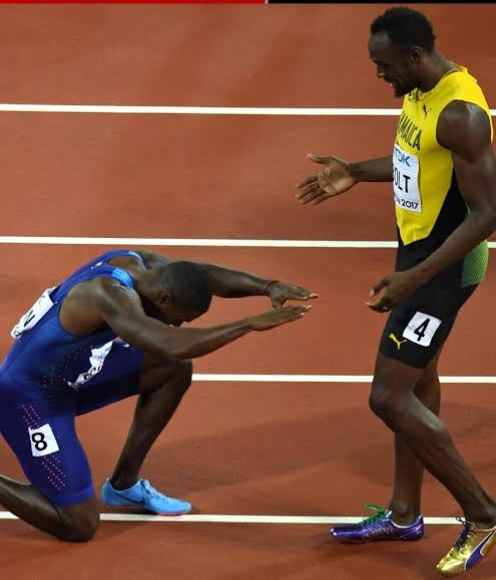
Gatlin studied those strengths. He did not dismiss them with mockery. He respected the late surge that had repeatedly denied him, the mental fortitude that allowed Bolt to seize the biggest moments, the almost supernatural stride that turned deficits into victories. That respect was not weakness; it was knowledge. Because Gatlin understood exactly what he was up against, he refined his own preparation, stayed composed under pressure, and finally overcame those strengths in 2017 at the World Championships in London. In Bolt’s farewell individual race, Gatlin produced a controlled performance to win gold in 9.92 seconds, with Bolt finishing third. Amid the boos of a hostile crowd, Gatlin walked over and bowed to the retiring champion—a spontaneous act of homage to the rival who had pushed him harder than anyone else. The bow was possible only because Gatlin had internalized Bolt’s greatness. Respect born of clear-eyed analysis of an opponent’s strengths enabled him to neutralize them and claim victory.
Rahul Gandhi’s conduct is the precise opposite. After three national defeats at Modi’s hands, he still appears to have no coherent grasp of the Prime Minister’s strengths—the ability to connect with a vast electorate, the disciplined messaging, the governance narrative that has repeatedly translated into mandates. Instead of studying those elements to craft a superior alternative, Rahul defaults to personal disrespect. The mockery and name-calling are not signs of confidence; they are symptoms of analytical emptiness. Without understanding what makes Modi formidable, there is nothing to overcome, only an endless cycle of frustration expressed as contempt. That ignorance fuels the disrespect, and the disrespect in turn blinds him further, ensuring continued electoral downfall. Gatlin respected Bolt because he knew the late surge’s power; that knowledge let him prepare to defeat it. Rahul Disrespects Modi because he seems to know neither the strengths nor the weaknesses, and that blindness keeps him losing.
In the end, greatness in public life—or on the track—is revealed as much by how one studies an opponent as by how one performs. Justin Gatlin, through years of being reeled in by Bolt’s late surges, chose respect rooted in understanding and ultimately prevailed. Rahul Gandhi, after serial defeats, chooses contempt rooted in apparent incomprehension and remains defeated. That is why the title fits. He is not merely a frequent loser at the ballot box. He is the ultimate loser because his reckless disrespect reveals a fundamental failure to comprehend the rival who keeps beating him—an ignorance that guarantees the cycle will continue. Until that changes, the verdict of the voters will keep delivering the same result, and the portrait of the perpetual, ungracious loser will only grow sharper.