
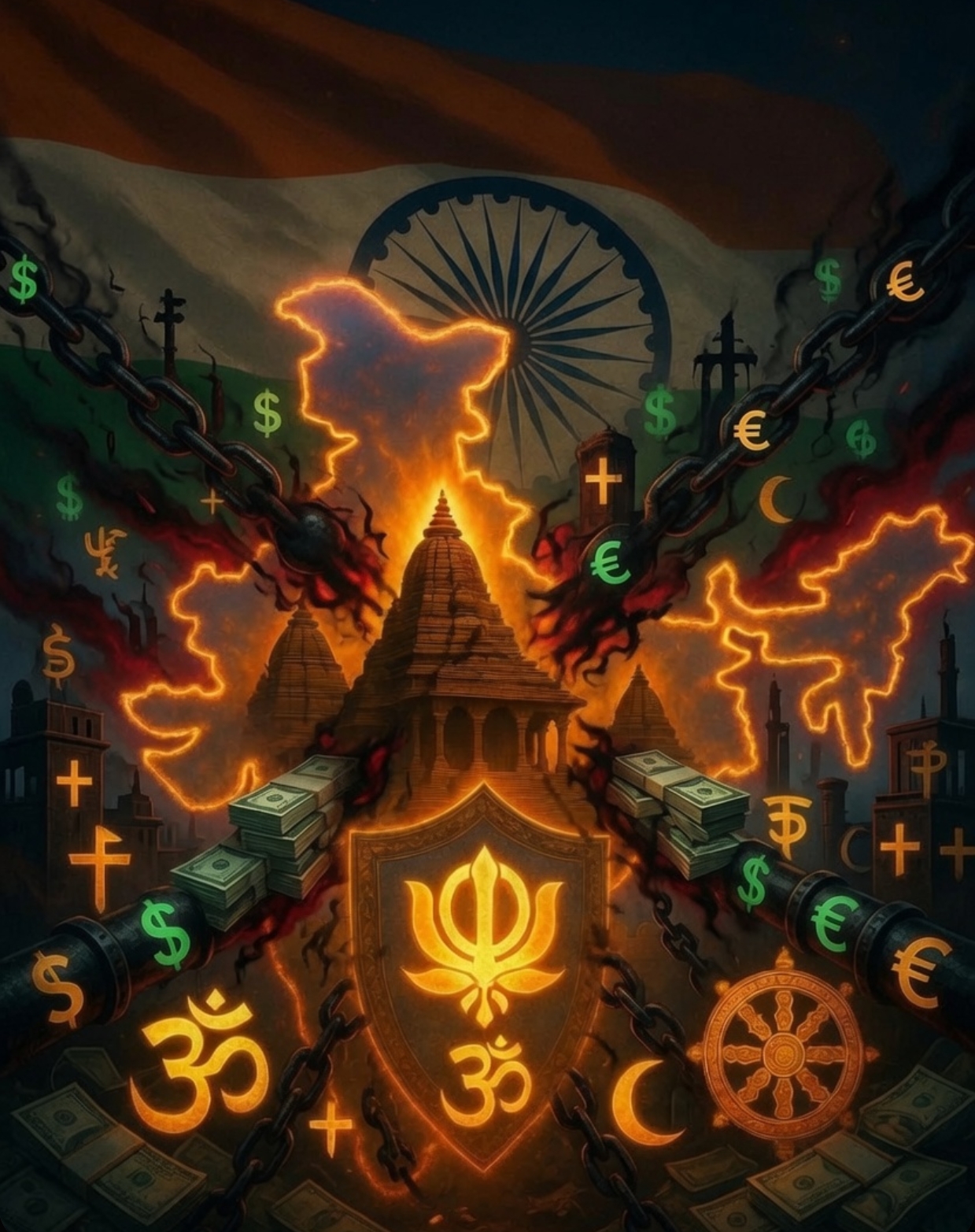
The Union Home Ministry’s recent amendments to the FCRA Rules, notified on 23 June 2026, represent a long-overdue assertion of national sovereignty. By explicitly excluding proselytisation from faith-based activities eligible for foreign funding, the government has drawn a clear line: foreign money will no longer subsidise efforts to alter India’s religious demographics under the guise of charity, education, or “development.”
This is not an attack on religion. It is a necessary defence of India’s native Indic traditions — Hinduism, Sikhism, Buddhism, and Jainism — which originated on this soil and form the civilizational bedrock of Bharat.
In simple terms, the Foreign Contribution (Regulation) Act already requires NGOs and associations receiving money from abroad to register and report how funds are used. The new rules tighten this framework significantly. Religious purposes are now narrowly defined: construction or maintenance of places of worship, promotion of devotional music, documentation of faith traditions, and preservation or revival of indigenous and tribal practices. Crucially, these activities must be carried out “excluding proselytisation.” NGOs must now specify exact purposes and the precise states or Union Territories where they will operate. Key functionaries are expected to be of Indian origin. There are minimum spending thresholds (at least ₹10 lakh over two years on approved activities), requirements to disclose ultimate donors, social media accounts, and detailed activity reports. Pre-existing registrations have a one-year window to comply with the new specificity rules.
These changes make it far harder for organisations to receive foreign dollars while quietly pursuing conversion agendas. “Religious education” or “faith preservation” can no longer serve as a Trojan horse for active efforts to bring people into non-Indic faiths. Transparency and accountability requirements will expose hidden funding chains and force genuine welfare work to stand on its own merits, without the sweetener of religious inducement.
Is this against India’s “Secular” values, as critics claim? I don’t know, and honestly there is a sense of fatigue amongst the majority, about carrying the baggage of upholding secularism. India urgently needs to preserve the demographic supremacy of its native religions. Demographic majorities are not about numbers alone; they shape the cultural DNA of a nation — its festivals, social norms, legal traditions, and collective identity. When foreign-backed actors systematically target vulnerable populations for conversion, they engineer long-term shifts that undermine social cohesion and national unity. History offers stark warnings. Partition itself was preceded by decades of communal mobilisation that altered local balances in key regions. Today, the risk is no less real: well-funded external campaigns that exploit poverty, caste, or tribal marginalisation to create new religious majorities in pockets of the country.
Look at Europe for a cautionary tale of what happens when demographic engineering through migration, higher fertility, and religious outreach proceeds unchecked. Muslim populations across Western Europe have grown rapidly over recent decades, from small minorities to 5–10% or more in countries like France, the UK, and Sweden. This shift has produced parallel societies, demands for Sharia accommodations, and integration failures on a massive scale. The grooming gang scandals in the UK stand as one of the most damning examples. In Rotherham alone, an estimated 1,400 girls – mostly white and working-class – were systematically raped, trafficked, and abused by networks of men predominantly of Pakistani Muslim heritage between the 1990s and 2010s. Official inquiries revealed that police and social services repeatedly failed to act out of fear of being labelled racist. Similar patterns emerged in Rochdale, Telford, and other towns. Recent reports estimate the national scale of such group-based child sexual exploitation could run into hundreds of thousands of victims. These were not isolated crimes; they reflected cultural attitudes, community insularity, and the confidence that comes with growing demographic and political weight. Native European identities and liberal values have come under strain as a result. India, with its ancient pluralistic traditions rooted in dharma rather than supremacist theologies, cannot afford to import similar dynamics through foreign-funded religious expansion.
Christian missionary efforts have long targeted India’s native populations, often with substantial foreign backing channelled directly or indirectly through NGOs. In the Northeast, decades of organised work transformed several states into Christian-majority regions, significantly eroding indigenous tribal faiths and impacting Buddhist communities in areas like Arunachal Pradesh. In Punjab, the Christian population has seen dramatic reported increases in recent years, with claims of hundreds of thousands of conversions. Foreign-funded pastors have conducted large-scale “healing meetings” and miracle crusades explicitly aimed at Sikh and Hindu populations, particularly the economically vulnerable. In South India and elsewhere, organisations have used foreign contributions to run extensive networks of schools, hospitals, and welfare programmes that critics document as serving as entry points for conversion among Dalits and tribals.
Specific past examples illustrate the scale. World Vision India, one of the largest recipients, received foreign contributions exceeding ₹233 crore in a single reported year and has been a top FCRA beneficiary for years. Its license faced suspension and eventual cancellation amid allegations of activities outside its mandate, including religious conversion. Believers Church India in Pathanamthitta, Kerala, received around ₹190 crore in foreign funds in one period. The Rural Development Trust in Ananthapur, Andhra Pradesh – linked to Spanish Jesuit founder Vicente Ferrer – also featured prominently among high recipients. In 2020, the Home Ministry suspended the FCRA licences of 13 NGOs operating in tribal-dominated areas (particularly Jharkhand) for allegedly indulging in religious conversions in violation of the Act; several had evangelical backgrounds, including the Northern Evangelical Lutheran Church, New Life Fellowship Association, and Evangelical Churches Association. Other prominent cases involved the Church’s Auxiliary for Social Action (CASA) and the Evangelical Fellowship of India, with licences affected over concerns of activities prejudicial to public interest and religious harmony. Reports indicate that a significant proportion – over 70% in some batches – of NGOs whose licences expired or were denied around 2022 were aligned with Christian programmes. Donors have included major US and European Christian organisations such as Compassion International and Kindernothilfe (Germany), funnelling funds that, while often framed as humanitarian, have been alleged to support indirect conversion efforts through welfare infrastructure.
Islamic outreach has followed parallel tracks, with substantial funding from Arab nations – particularly Saudi Arabia and other Gulf states – to promote a specific conservative strain of Islam, alongside allegations of support from Pakistani sources. Saudi funding has supported the construction of mosques, madrasas, and seminaries across India, especially in Kerala and Jammu & Kashmir. Concrete examples include millions of riyals directed to the Islamic Mission Trust of Malappuram (Kerala), the Islamic Welfare Trust, and the Mujahideen Arabic College in Palakkad for Salafi-oriented activities. In Jammu & Kashmir, Saudi-linked influence helped Jamiat Ahl-e-Hadith build approximately 700 mosques and 150 schools, with reports of significant affiliation among the population. A 2005 Saudi-approved plan reportedly earmarked billions for mosques and madrasas across South Asia, including India, alongside distribution of religious literature and stipends for preachers. Additional support has gone to universities such as Jamia Millia Islamia and various Salafi charities and organisations. Gulf funding, often channelled through remittances from Indian workers or direct grants to local trusts, has similarly bolstered madrasas and institutions in Kerala and other regions. While presented as religious or educational support, such funding has been linked to the promotion of Wahhabi/Salafi ideologies that encourage dawah (proselytisation) and shifts away from traditional Indian Islamic practices toward more Arabised and separatist forms.
In addition to Arab nations, there have been documented allegations and intelligence-based reports of Pakistani involvement directly or indirectly, in supporting Islamist activities in India that intersect with religious promotion and radicalization. Due to strained bilateral relations, large-scale direct funding through formal FCRA-registered NGOs is extremely rare and heavily scrutinized. However, Pakistan’s Inter-Services Intelligence (ISI) has long been accused of channeling resources via informal routes such as hawala networks and front organizations to support militant Islamist groups operating in India, particularly in Jammu & Kashmir. Groups like Lashkar-e-Taiba (LeT, with its charitable arm Jamaat-ud-Dawa) and Jaish-e-Mohammed (JeM) have received such support, often using religious propaganda, dawah, and madrasa networks as part of broader mobilization efforts. Recent probes provide further examples: In Uttar Pradesh, authorities busted major conversion rackets (including cases in Agra), with investigations into masterminds like “Changur Baba” (Jamaluddin) revealing confessions of receiving funding linked to Pakistan. These cases highlight how external funding can fuel organized efforts at religious change, sometimes intertwined with radical networks.
These are not isolated incidents but documented patterns of foreign funding — both direct (via FCRA-registered NGOs receiving crores from Western Christian donors and Arab sources) and indirect (through international charities, Gulf remittances, hawala, or layered proxies). Past FCRA enforcement actions, including the cancellation or suspension of thousands of licences over the years (more than 20,000 cumulatively in some periods), repeatedly highlighted misuse for conversion-related activities.
The previous FCRA regime had loopholes that allowed these activities to continue under the broad umbrella of “religious” or “social” work. Funds could be routed through layered NGOs, used for infrastructure that doubled as conversion hubs, or spent on “education” and “welfare” that subtly or overtly encouraged shifts in faith. Many organisations faced cancellation only after prolonged violations came to light. The new amendments close these gaps decisively. By carving proselytisation out of permissible religious purposes, they remove the legal cover for conversion-driven work. Specificity requirements mean an NGO cannot claim broad “faith-based” status while operating conversion programmes in multiple states. Indian control over key positions reduces the ability of foreign entities to direct operations from afar. Spending and reporting rules make it difficult to stockpile funds for long-term demographic projects or hide activities behind opaque accounts. These measures build on past enforcement – such as actions against World Vision India, the 2020 tribal NGO suspensions, and probes into conversion rackets with foreign links, by making proactive prevention the norm rather than reactive cancellation.
These measures do not ban voluntary personal conversions or genuine charitable work by any community. They simply ensure that foreign governments, churches, wealthy donors, or state-linked networks cannot treat India as a marketplace for souls using Indian poverty or vulnerabilities as leverage. Native religions of Bharat have survived centuries of invasions, temple destructions, and coercive pressures precisely because they retained demographic and cultural primacy on their own soil. Allowing well-resourced external actors to reverse-engineer that balance through financial inducement is neither secularism nor pluralism — it is subsidised demographic subversion.
India’s strength has always lain in its civilizational continuity. The FCRA amendments affirm that continuity by ensuring religious change, if it occurs, remains an internal, uncoerced matter rather than a foreign-orchestrated project. In an era of hybrid influence operations, protecting the demographic and cultural core of the nation is not optional. It is fundamental to preserving Bharat as Bharat. The government has taken a principled step. It deserves support from all who value India’s indigenous heritage over imported agendas.


