
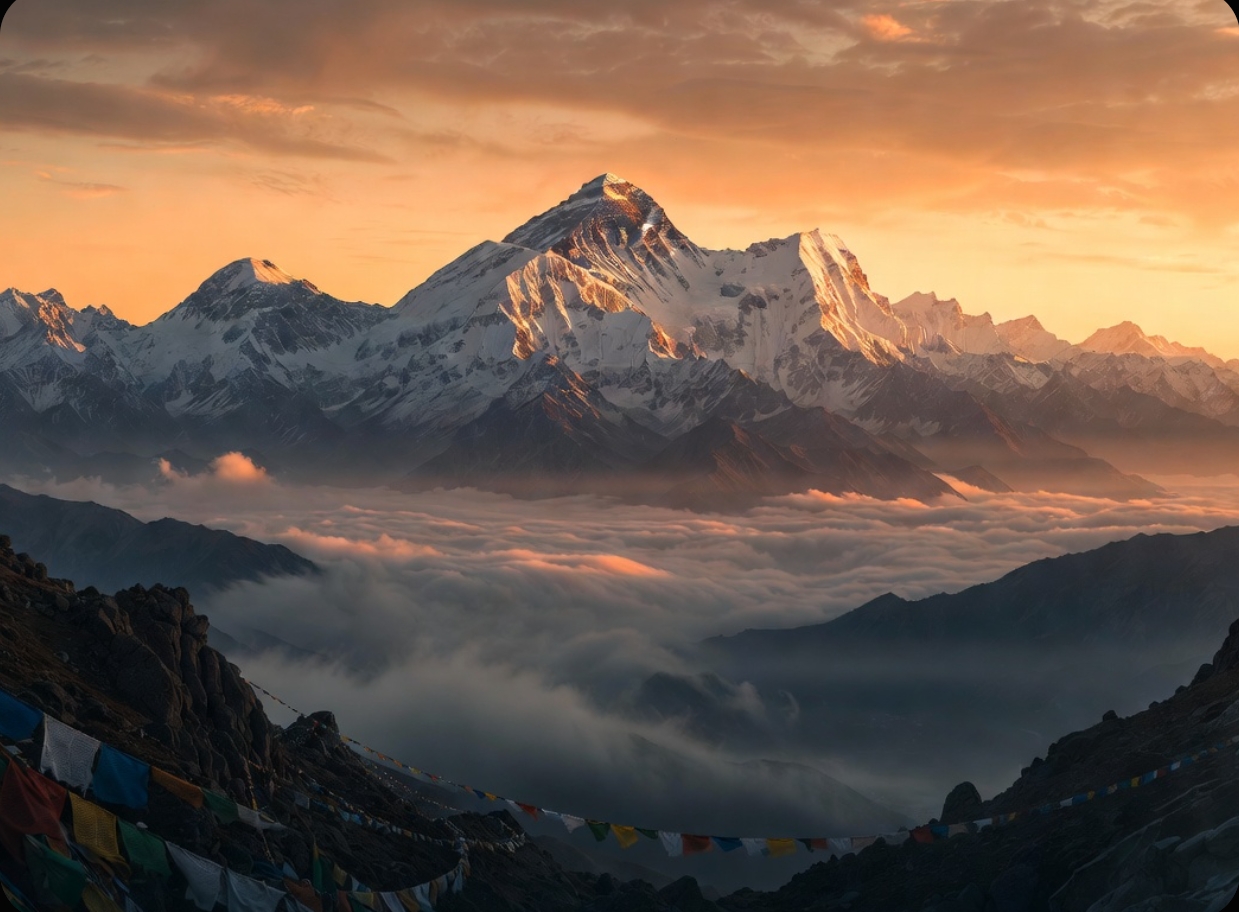
On the crisp morning of May 29, 1953, two men stood at the pinnacle of the world. New Zealander Edmund Hillary and Nepali Sherpa Tenzing Norgay, roped together as one team, planted their feet on the highest point on Earth. After battling ferocious winds, bone-chilling cold, and the thin air of the death zone, they gazed out across the vast Himalayan expanse. This marked the first confirmed human ascent of the majestic peak known locally as Sagarmatha. Their achievement, part of the British expedition led by John Hunt, sent shockwaves of triumph around the globe and etched their names in history.
Yet even as the world celebrated this modern conquest, few paused to ask why this sacred Himalayan giant carried the name “Mount Everest” at all? The answer lies in the 19th century, during the era of British colonial surveys across India. Surveyors of the Great Trigonometrical Survey meticulously mapped the towering ranges visible from the Indian plains. They designated the unknown giant as “Peak XV.” When its extraordinary height was confirmed in 1856 – standing taller than any other known summit – Andrew Waugh, the Surveyor General of India and successor to Sir George Everest, proposed naming it after his predecessor. The Royal Geographical Society officially adopted “Mount Everest” in 1865.
Sir George Everest himself objected to the honor. He believed geographical features should retain their local or indigenous names and noted that his surname would be difficult for people across India and Nepal to pronounce or write. Despite these protests, the colonial administration’s choice prevailed. The mountain, long revered by those who lived in its shadow, received an English name imposed from afar.
Local communities had their own names rooted in deep cultural reverence. In Nepal it is Sagarmatha – meaning the “Forehead of the Sky” or “Peak of Heaven.” Across the border in Tibet, it is Chomolungma, evoking the “Goddess Mother of the World.” These names reflect centuries of spiritual connection to the mountain as a divine presence rather than a mere physical obstacle.
The story of Sagarmatha stretches far deeper into time. Sacred Hindu scriptures record profound connections to this towering Himalayan peak. In the Matsya Purana and passages of the Mahabharata, we encounter the account of the great deluge. During this cataclysmic flood, Lord Vishnu manifested as the Matsya avatar – a divine fish – to guide Vaivasvata Manu. Manu was instructed to build a sturdy boat, gather Saptarishi – the seven great sages, seeds of all life, and living beings. As the waters rose, the boat was pulled to safety and securely tied to the horn of the fish using the serpent Vasuki.
The vessel came to rest against the loftiest peak that remained above the surging waters – the highest summit in the Himalayas. This peak is explicitly named “Naubandhana” in the scriptures, literally meaning “the binding of the boat” or “boat-binding.” The Mahabharata describes it clearly: “That is the peak called Naubandhana, beyond the Himalayas. It is still well known.” Some traditional understandings identify this Naubandhana with Sagarmatha itself – the very summit where the boat of life was anchored, marking the renewal of creation after the flood. This reference in the Sacred Hindu scriptures underscores the mountain’s ancient spiritual significance, portraying it as a place of divine refuge and cosmic importance long before modern exploration.
Given these deep roots in Sacred Hindu scriptures, a natural question arises – Could ascetics, sadhus, or yogis known for their extraordinary endurance, spiritual discipline, and mastery over the body, have reached the summit of Sagarmatha centuries or even millennia earlier?
While faith traditions speak of remarkable feats of human potential and the sacred power of the Himalayas, historical and scientific records offer no verified evidence so far, of any successful summit before 1953. The physiological realities of extreme altitude are formidable. Above 8,000 meters lies the death zone, where oxygen is so scarce that the human body begins to deteriorate rapidly without supplemental support. Modern climbers rely on bottled oxygen, carefully planned acclimatization, specialized clothing, and equipment to survive. Ancient travelers lacked these aids.
Local communities around Sagarmatha have long held the mountain in profound reverence, viewing it as the abode of deities. Traditional Hindu/Buddhist practices centered on respect, pilgrimage to lower sacred sites, and offerings rather than attempts to stand atop the summit.
Early 20th-century expeditions by Western teams in the 1920s and 1930s pushed higher than ever before but fell short of the top. The 1924 effort by George Mallory and Andrew Irvine remains one of history’s great mysteries – they were last seen high on the mountain but did not return, and conclusive proof of a summit has never been established.
Thus, when Hillary and Tenzing stood victorious in 1953, they achieved what no recorded human endeavor had accomplished before – the first confirmed ascent of Sagarmatha.
Today, as the world reflects on this extraordinary peak, it is time to confront the lingering shadow of colonial naming practices. Nepal, the host nation, officially embraced Sagarmatha as its name for the mountain in 1956, honoring its cultural and spiritual heritage. The international community, through bodies such as the United Nations Group of Experts on Geographical Names (UNGEGN), now has an opportunity to act with grace and fairness.
It is time to shed the colonial baggage that imposed an external name against the wishes of even the man it honored and against the living traditions of the region. The world should respectfully and without any bias toward any particular heritage accept Sagarmatha as the universal official name for this sacred summit. Such a step would honor the mountain’s ancient legacy recorded in Sacred Hindu scriptures, respect Nepal’s sovereign choice, and recognize the profound cultural identity it holds for the people who have lived beside it for generations.
Sagarmatha has always been more than a mountain to conquer. It is a symbol of endurance, renewal, and the enduring connection between humanity and the divine heights. Let its true name rise, as it has for millennia, above all others.


