
Date: September 8, 2024
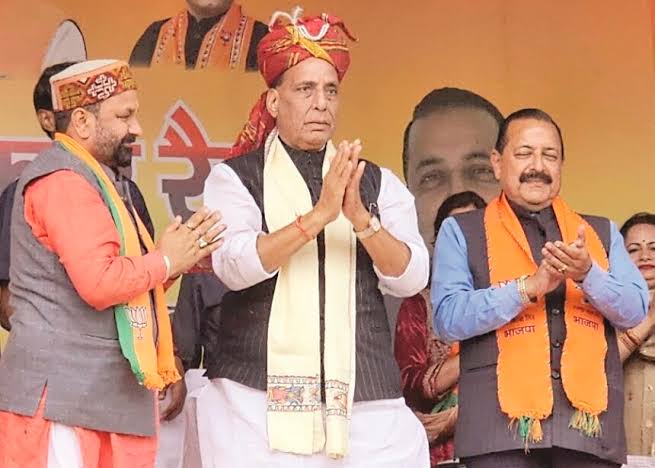
Ramban, Jammu and Kashmir – In a significant political statement, Union Defence Minister Rajnath Singh has extended an invitation to the residents of Pakistan-occupied Jammu Kashmir (PoJK) to join India, emphasizing a stark contrast in how the two nations view the region’s inhabitants. Addressing a rally in Jammu and Kashmir’s Ramban assembly constituency, Singh highlighted India’s inclusive approach, stating, “We consider you our own unlike Pakistan which treats you as foreigners.”
Singh’s remarks come in the backdrop of the upcoming assembly elections in Jammu and Kashmir, where the Bharatiya Janata Party (BJP) is campaigning vigorously. He used the platform to not only appeal to the local electorate but also to send a message across the border, suggesting that the development witnessed in Jammu and Kashmir post the abrogation of Article 370 in August 2019 could serve as a beacon for PoK residents. “There will be so much development that the people in PoK on seeing this should say that we do not want to live with Pakistan and instead will go to India,” Singh proclaimed.
The Defence Minister’s speech also took a critical stance against the opposition’s promise to restore Article 370, dismissing it as an impossibility under BJP’s governance. He praised the transformation in Jammu and Kashmir, where, according to him, the youth now carry laptops and computers instead of pistols and revolvers, symbolizing a shift from conflict to progress.
This call to PoJK residents reflects a broader narrative within Indian politics, where the integration of PoJK into India has been a long-standing demand, often used to galvanize nationalist sentiments. Singh’s invitation, however, adds a layer of humanitarian and developmental appeal, suggesting that the path to unification could be paved by the visible benefits of development and inclusive governance rather than through conflict.
The rally also saw Rajnath Singh touch upon the BJP’s vision for Jammu and Kashmir, promising to make it a model state in terms of development if voted to power. He criticized previous narratives of fear and conflict, asserting that under Prime Minister Narendra Modi’s leadership, border villages are now seen as the “first villages of the country” rather than the last, promising rapid development and security.
This political outreach, while symbolic, underscores the ongoing geopolitical tensions and the cultural, historical, and emotional ties India claims with PoJK. Singh’s statements, echoed across various platforms including X (formerly Twitter), have sparked discussions on the feasibility and implications of such a move, reflecting both hope and skepticism among observers and analysts.
The invitation to PoJK residents to join India not only serves as a political strategy but also highlights the BJP’s confidence in its governance model and its appeal beyond India’s current borders, aiming to resonate with a sense of belonging and shared identity among Kashmiri people on both sides of the Line of Control.


