
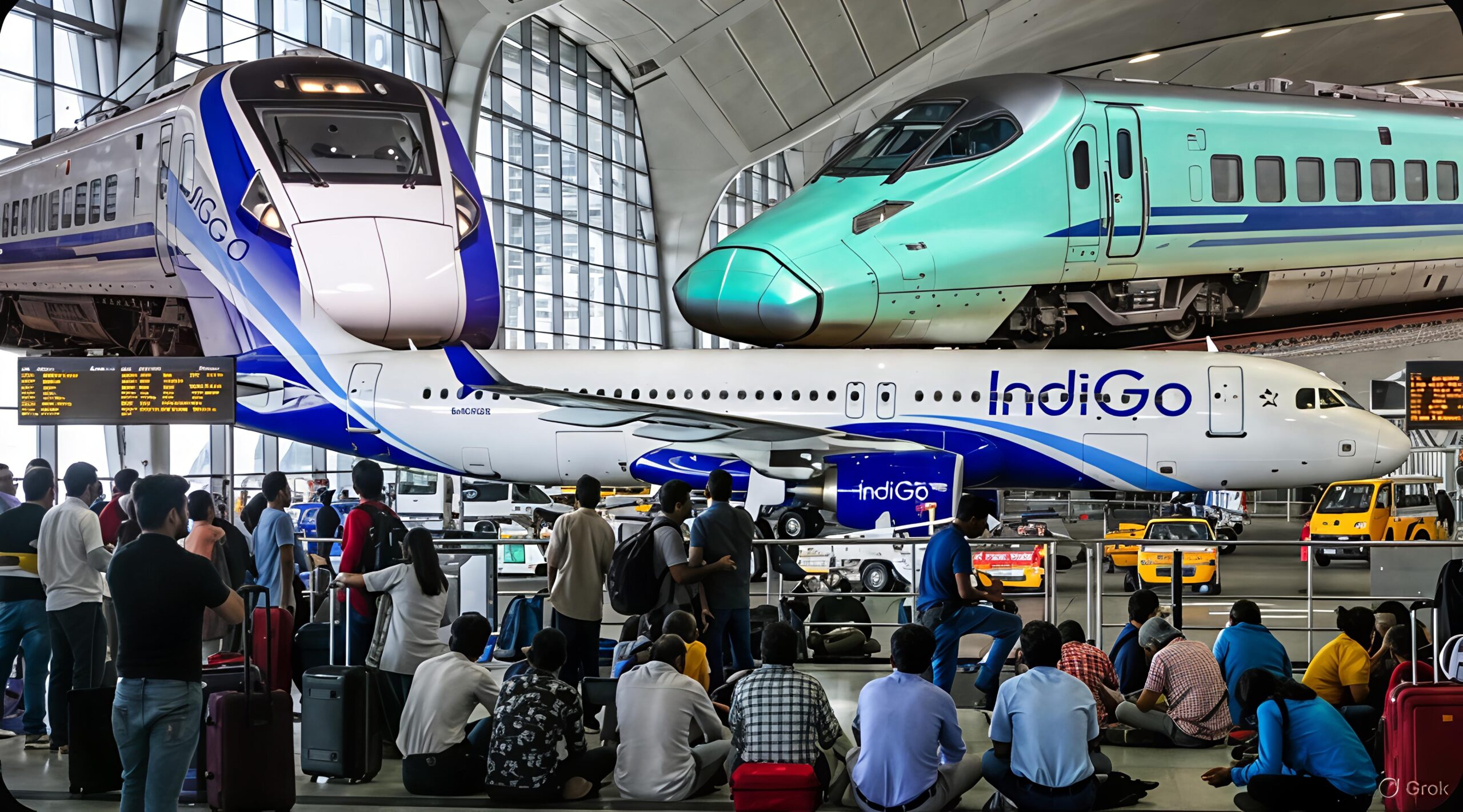
On 5 December 2025, Indian airports looked less like gateways to the sky and more like overcrowded relief camps. IndiGo, the airline that carries over 60% of domestic India, cancelled more than a thousand flights in a single week. The stated reason was a sudden “pilot shortage”. The real reason is structural fragility built over two decades of blind faith in imported aviation.
Every aircraft in IndiGo’s fleet was bought or leased in dollars, is maintained in dollars, burns fuel priced in dollars, and is increasingly flown by pilots whose foreign training was paid for in dollars. When the rupee slides, when oil crosses $80 a barrel (as it has throughout most of 2025), when lessors repossess planes for missed payments, or when global supply chains cough even once, the entire sector goes into seizure. Kingfisher 2012, Jet Airways 2019, GoFirst 2023, SpiceJet on permanent oxygen — the script is identical. Only the airline logo changes.
The current pilot crisis did not arrive unannounced. India produces barely 1,000 new commercial pilots a year against a requirement of 2,500–3,000 just to keep pace with fleet growth. The United States, with one-fourth our population, has over 160,000 active pilots. We expanded seats by 20–25% annually for a decade while treating pilot training as someone else’s problem. The chickens have now come home to roost — and they are wearing captain’s stripes.
Now move out of Airport terminal and look at the railway platform. A very different India is on display.
Indian Railways has just completed one of the fastest electrification drives in history: 99% of broad-gauge routes now run on electricity. Over 75 Vande Bharat Express trains — 95% indigenously designed and manufactured — are already in service, with another 400 on order. These are not propaganda models; they are daily proof that India can master complex, high-technology transport systems from drawing board to daily service.
A Delhi–Lucknow Vande Bharat (500 km) takes five-and-a-half hours and costs ₹1,200 in Chair Car — 75–80% cheaper than the cheapest IndiGo ticket on the same route before the meltdown began. Mumbai–Ahmedabad Tejas does the same distance in six hours for ₹1,400 against ₹6,000–12,000 for a last-minute flight. Add airport hassle, security lines and baggage wait, and the train is frequently faster door-to-door. The cost advantage only grows as jet fuel stays expensive.
The deeper case is strategic. Every rupee spent on imported aviation fuel or lease rentals leaves India forever. Every rupee spent on electricity for a Vande Bharat recirculates inside the country: coal from Indian mines, solar panels from Indian factories, wages to Indian workers, profits to Indian manufacturers in Madhepura, Marhowrah and Rae Bareli. The multiplier effect on jobs, skills and balance-of-payments is massive.
Aviation on the other hand, is a vulnerability dressed up as modernity. The Ukraine war showed how quickly aircraft become museum pieces when spare parts are sanctioned. A single tweet from Riyadh or a boardroom decision in Toulouse or Seattle can ground half our fleet. Railways give us the opposite geometry: mature technology, domestic supply chains, and fuel we generate ourselves from coal, hydro, nuclear, solar or wind.
Three additional transformations are now underway that make the railway alternative even more compelling:
First, India must adopt the European/Japanese/Chinese frequency revolution. On the busiest corridors — Delhi–Mumbai, Delhi–Kolkata, Mumbai–Bengaluru, Bengaluru–Chennai, Delhi–Chennai — trains should run every 30 to 60 minutes from 6 a.m. to midnight. Combine this with a genuine “turn-up-and-go” ticketing model: buy on the day via UPI or the UTS app, tap your phone at the gate, and board the next departure. No more 60-day advance booking wars, no more tatkal touts. Tokyo’s Yamanote Line, Paris RER, and Beijing–Shanghai high-speed services already work this way. When frequency reaches metro-like levels, load factors rise above 90%, unit costs crash, and airlines simply cannot compete on price or convenience.
Second, the railway is quietly conquering the most difficult frontiers on earth, delivering both economic integration and national security dividends no airport ever could. The USBRL project in Kashmir is substantially complete: trains already run to Baramulla, and the iconic Chenab Bridge — the world’s highest railway arch — was commissioned in 2025. The 111-km Rishikesh–Karnprayag line in Uttarakhand, with 105 km of tunnels through fragile Himalayan geology, is an engineering feat rivaling the Gotthard Base Tunnel. In the Northeast, the Jiribam–Imphal and Sivok–Rangpo lines will soon connect Manipur and Sikkim by broad gauge for the first time. Most breathtaking of all is the proposed 465-km Bilaspur–Manali–Leh line that will climb to 5,300 metres above sea level — the highest railway on the planet. Once operational, India will be able to move an entire mountain division with heavy armour and artillery to the Ladakh frontier in days rather than weeks. Leh airport, heroic though it is, shuts down for months in winter. A railway will not.
Third, the passenger experience is being dragged into the 21st century. Over 1,300 stations are being rebuilt under the Amrit Bharat scheme with airport-style interiors, rooftop plazas, segregated arrivals/departures, and direct metro/RRTS/bus connectivity. Kavach, India’s indigenous automatic train-protection system, already covers more than 10,000 route-km by December 2025 and is expanding at 5,000 km per year. High-density corridors are being fenced to eliminate trespassing and cattle hits. Multi-modal integration is becoming real: a single QR ticket can already take you from a Tier-3 town by state bus to the railway station, then Vande Bharat to the capital, then metro to your final destination. The railway is morphing into a seamless national mobility backbone.
None of this means India should ground its airlines tomorrow. International long-haul, island territories, and emergency medical evacuation will always need wings. But for the 90% of domestic passenger-kilometres that occur on trunk routes under 800 km, semi-high-speed and high-frequency rail is now cheaper, greener, more reliable, more secure, and increasingly more convenient.
The IndiGo crisis is therefore not merely an airline’s headache; it is a national inflection point. Every cancelled flight is a potential lifelong rail convert. Every viral video of chaos at airport counters is free advertising for the quiet, air-conditioned Vande Bharat waiting on the next platform.
The policy menu is ready: divert a slice of the aviation turbine fuel cess to high-speed corridors; mandate 30-minute frequencies on the top ten city pairs by 2032; complete the strategic frontier lines on war footing; and make the Ahmedabad–Mumbai bullet train the springboard for fully indigenous 300+ km/h technology by the middle of the next decade.
Modernity should no longer be measured by how many imported jets we can keep in the air, but by how much of our mobility we can design, build, power, and defend ourselves. On that scoreboard, a clean, electrified, Kavach-protected platform with saffron-and-white Vande Bharat trains departing every 30-60 minutes — all the way from Kanyakumari to Kashmir and, soon, to the roof of the world in Leh — looks infinitely more futuristic than any dollar-denominated, pilot-starved Airbus parked on a remote bay.
The skies belong to those who control the oil and the supply chains. The tracks belong to us. It is time we travelled on them — and, when needed, defended our borders with them.


Goog Article