
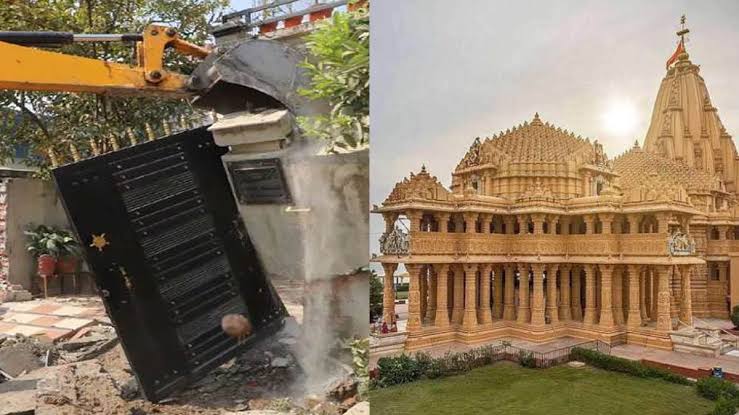
Somnath, Gujarat, January 27, 2024 – In a bold move to preserve the sanctity and enhance the security of one of India’s most revered temples, the Gujarat government, under the guidance of the Shree Somnath Trust, has undertaken a significant demolition drive around the Somnath Temple. This operation, which saw the removal of unauthorized structures, is not just about reclaiming land but is deeply intertwined with the historical and cultural narrative of India.
The Somnath Temple, standing majestically on the shores of the Arabian Sea, has been a symbol of resilience. Its history is marked by repeated attacks, most notably by Mahmud of Ghazni in 1026, who plundered and destroyed the temple, an event that has been etched in the collective memory as a stark reminder of the vulnerabilities of sacred Hindu Temples to historical Islamic invasions.
The temple’s repeated destruction and resurrection symbolize the undying spirit of regeneration. In recent times, the temple’s surroundings had become encroached upon, leading to not just an aesthetic blight but significant security concerns. The decision by the Gujarat government to clear approximately 3 hectares of land belonging to the temple trust was both necessary and timely.
Here’s why this move deserves applause:
1. Security Reinforcement: Historically, the Somnath Temple has been a target of Islamic radical forces due to its religious significance for Hindus. Encroachments close to such a site pose not just a security risk but could potentially serve as cover for more nefarious activities. Clearing these structures significantly reduces these risks, making the area more secure for pilgrims and tourists alike.
2. Cultural Integrity: The Somnath Temple isn’t just a place of worship; it’s a monument of national importance, reflecting India’s historical struggle and cultural continuity. By removing unauthorized constructions, the government is preserving the visual and spiritual integrity of this site.
3. Tourism and Development: Somnath, being among the 12 Jyotirlingas, attracts millions of devotees and visitors. A clutter-free, well-maintained environment enhances the pilgrimage experience, potentially boosting local tourism, which in turn supports community development.
4. Historical Lessons: The drive can be seen as a proactive measure inspired by history. Given the temple’s past, where its destruction was often a display of power by Islamic invaders, ensuring its surroundings are clear and controlled is a symbolic and practical move to prevent history from casting any shadow again.
Critics might crib about the displacement caused by such drives, but in the broader perspective of national heritage and security, these measures are not just justified but essential legally followed practice in every civilized society across the World. The Gujarat government’s initiative, while it may seem harsh to some, is a forward-thinking approach to safeguard a symbol of India’s identity and resilience.
The collaboration between the state government and the Shree Somnath Trust in this endeavor not only clears physical space but also sends a message of strong governance, respect for history, and a commitment to protecting India’s cultural landmarks. This action, therefore, isn’t merely about demolition; it’s about building a safer, more dignified space for faith, history, and culture to thrive undisturbed.


