
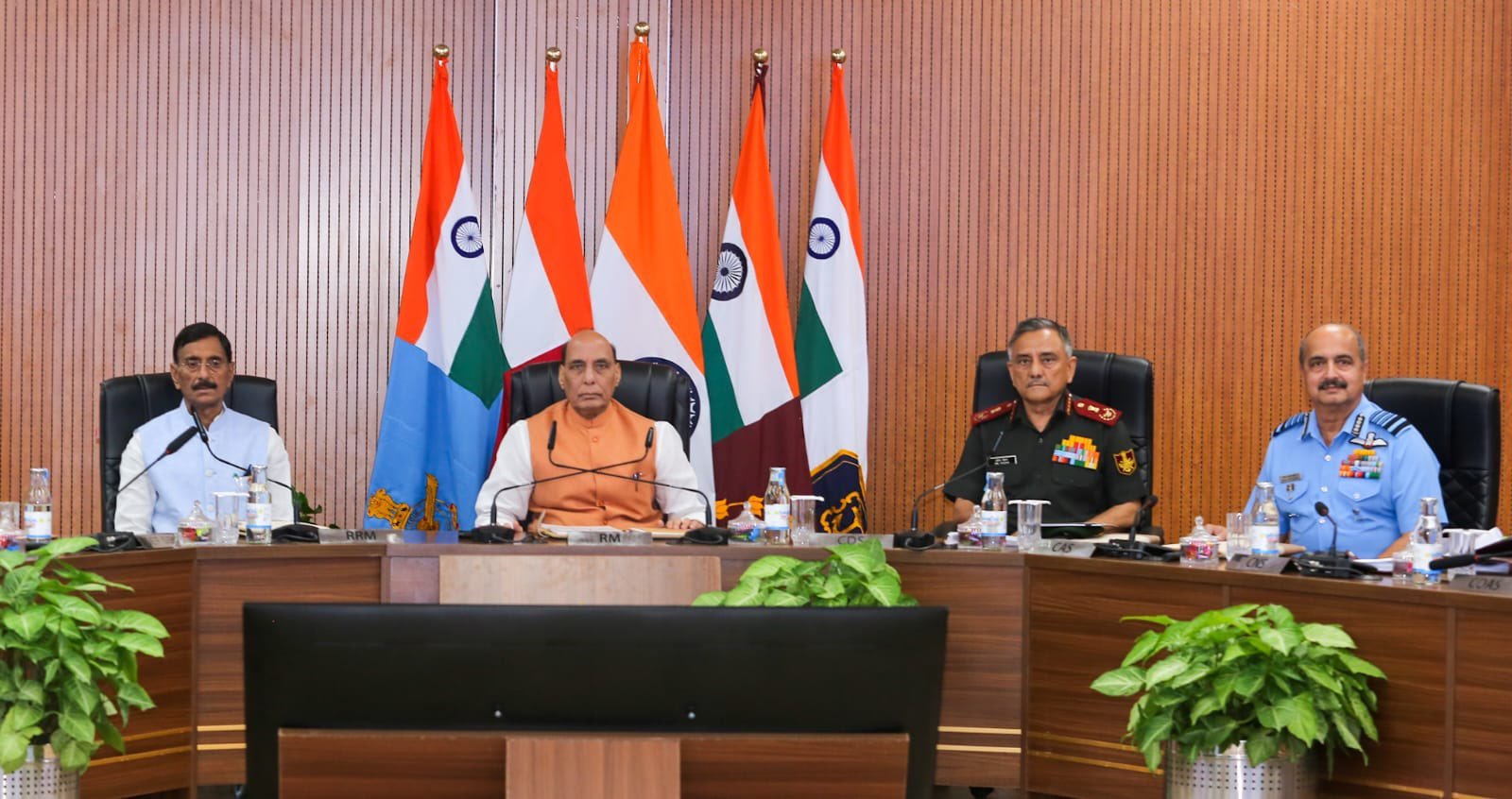
Lucknow, Uttar Pradesh – In a historic move towards enhancing military cohesion and strategic foresight, the first-ever Joint Commanders’ Conference (JCC) was inaugurated in Lucknow on September 4, 2024, under the theme ‘Sashakt aur Surakshit Bharat: Transforming the Armed Forces’. This conference, attended by Defence Minister Rajnath Singh, Chief of Defence Staff General Anil Chauhan, and other top military brass, marked a pivotal moment in India’s defense strategy, focusing on jointness, integration, and technological advancement within the armed forces.
Defence Minister Rajnath Singh, in his address, underscored the importance of a unified military vision. “We are not just preparing for peace but ensuring we are ready for any eventuality to preserve that peace,” Singh stated, emphasizing the need for India’s military to adapt to future warfare scenarios. His speech highlighted the government’s commitment to ‘Aatmanirbhar Bharat’ (Self-reliant India), pushing for indigenous defense production and technological self-sufficiency.
The conference, which spanned over two days, delved into several critical areas:
- Jointness and Integration: A significant portion of the discussions revolved around creating a more integrated military structure. The introduction of theatre commands, aimed at streamlining operations against potential threats from China and Pakistan, was a focal point. This restructuring seeks to ensure that the army, navy, and air force operate with greater synergy, reducing response times and enhancing operational effectiveness.
- Technological Advancements: Singh stressed the integration of cutting-edge technologies like AI, data analytics, and space warfare capabilities into military operations. The conference saw the launch of digital tools designed to boost tri-service synergy, indicating a shift towards a more tech-savvy military apparatus.
- Strategic Autonomy: The discussions also touched upon India’s strategic autonomy in defense, with a strong emphasis on reducing dependence on foreign military hardware. This aligns with broader national goals of self-reliance, especially in critical sectors like defense.
- Future Warfare: With insights drawn from global conflicts, particularly those involving unconventional warfare tactics, the conference aimed at preparing the military for asymmetric threats. This includes cyber warfare, electronic warfare, and space operations, areas where India aims to fortify its capabilities.
The JCC not only reviewed the blueprint for theatre commands but also served as a platform for exchanging ideas on how India’s military can evolve. General Anil Chauhan, in his address, spoke about the imperatives of ‘Jointness 2.0’, advocating for a cultural shift within the military towards more collaborative operations.
The conference concluded with a clear message: India’s military is at the cusp of transformation, not just in structure but in its operational philosophy. This transformation is geared towards meeting the challenges of the 21st century, where traditional warfare boundaries blur, and technology plays an ever-increasing role.
As India moves forward with this new military vision, the outcomes of the JCC are expected to shape not just defense policies but also influence broader national security strategies, ensuring India remains a formidable force in the region and beyond.


