
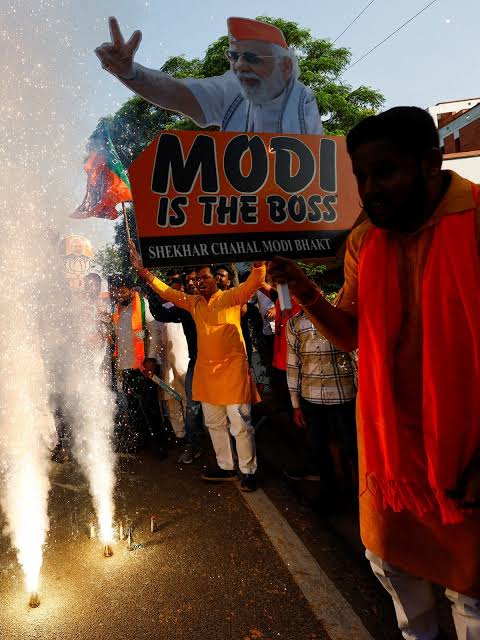
In an electoral outcome that stunned political analysts and confounded exit polls, the Bharatiya Janata Party (BJP) secured a historic third term in Haryana, showcasing an unexpected resilience against the tide of anti-incumbency. This victory, which saw the BJP not only retain power but also expand its mandate, has opened up discussions on the dynamics of Indian politics, particularly the influence of the Rashtriya Swayamsevak Sangh (RSS) and what might be perceived as the Congress’s miscalculation on religious sentiment.
The Exit Poll Paradox
The Haryana election results were a direct challenge to the predictive power of exit polls, which had largely indicated a potential shift towards the Congress. Analysts now speculate on the reasons behind this misprediction, pointing towards a failure to accurately gauge the undercurrents of voter sentiment. The BJP’s victory, against the backdrop of these predictions, underscores a disconnect between traditional polling methodologies and the nuanced political climate in a country like India.
RSS’s Strategic Maneuver
The RSS, often seen as the ideological fountainhead of the BJP, played a pivotal role in this election, orchestrating a grassroots resurgence. Reports from the ground suggest that the RSS mobilized its extensive network for door-to-door campaigns, focusing on community engagement that often goes under the radar of mainstream political analysis. This micro-management, coupled with a strategic alignment of local issues with nationalistic fervor, might have tilted the scales in BJP’s favor. The RSS’s involvement was not just about numbers but about rekindling a sense of cultural and religious identity, which, in Haryana, seemed to resonate deeply.
Congress’s Alleged Anti-Hindu Stance
The Congress party’s campaign, though centered around misplaced rhetorics on governance issues like unemployment and agriculture, inadvertently became entangled in religious sentiment, as Development and employment is BJP’s turf. Critics within political circles and on social media platforms like X (formerly Twitter) labeled Congress’s strategic missteps as an ‘anti-Hindu’ stance, primarily due to its actions of Muslim appeasement and alliances that alienated Hindu voters. This narrative, whether intended or not, was amplified by BJP’s campaign machinery, which adeptly turned the focus towards identity politics, a domain where the BJP has historically held an advantage.
Congress’s Strategic Failures
The Congress’s defeat can be dissected through several lenses:
– Misreading the Room: Congress’s assumption that economic and social issues would overshadow cultural identity underestimated the electorate’s mood. This miscalculation was evident in their approach, which failed to counter the narrative effectively.
– Fragmented Leadership: The party’s inability to present a unified front, compounded by internal rifts and perceived favoritism towards certain regions or castes, weakened its appeal. The backlash against key Congress figures for neglecting broader community interests illustrates a strategic oversight.
– Communication Gaffe: The party’s communication strategy, which might have inadvertently reinforced the ‘anti-Hindu’ label through selective alliances or statements on sensitive issues, played into BJP’s hands. This perception gap was critical in a state where cultural identity holds significant electoral weight.
BJP’s Strategic Wins
The BJP’s strategy was multi-faceted:
– Cultural Connect: By aligning with the RSS’s grassroots work, BJP tapped into a narrative of cultural preservation and pride, which in Haryana, with its strong martial and agrarian ethos, proved potent.
– Counter-Narrative: BJP effectively managed to counter the anti-incumbency with a narrative of development intertwined with nationalistic themes, making the vote a choice between development with cultural preservation versus perceived neglect by Congress.
– Voter Mobilization: The use of technology, combined with traditional canvassing, ensured that the BJP’s message reached even the remotest voter, leveraging both emotional and rational appeals.
Conclusion
The Haryana election results are a testament to the evolving nature of Indian politics where traditional political algebra must now account for cultural and religious sentiment, voter mobilization at the micro-level, and the strategic deployment of narratives. The BJP’s victory, under the shadow of RSS’s organizational prowess, against the backdrop of Congress’s strategic missteps, particularly around religious sentiment, offers lessons on the power of identity politics in contemporary India. This election might well be remembered as a moment when the political landscape of Haryana, and perhaps by extension, India, witnessed a significant shift in voter behavior, challenging established political narratives and exit poll methodologies alike.


